
What if our planners understood when we were most energized and adapted accordingly?
Wellness
2025
UX Designer
Mobile App
YEAR
ROLE
TYPE
INDUSTRY
The Dynamic Scheduling
Situation
Action
Result
Users over-schedule during low-energy periods. No tool asks how you actually feel.
Designed FlexPlan, a scheduler that adapts to your energy, not just your time.
A living schedule that flexes with your rhythm. Focus when sharp. Rest when depleted.
Users over-schedule during natural low-energy dips, post-lunch, late evening.
Task priority and personal readiness are treated as completely unrelated.
Rigid frameworks leave zero room for the unpredictability of real life.
01 Problem
01
02
03
Every task app I've used suffers from the same flaw. Yesterday's unfinished items bleed into today. The list grows. The dread grows with it. You open the app not to plan your day, but to be confronted by everything you haven't done yet.
This isn't a motivation problem. It's a design problem. The app is working exactly as intended, it's just optimising for completeness over clarity.
The guilt cycle nobody talks about
Participants logged energy and planning decisions 3× daily using a Notion template.
4 participants · 3 days · Morning / afternoon / evening
Diary study
Attitudinal questions about tools used, satisfaction, and planning pain points.
18 respondents · 8 questions · Google Forms
Survey
Semi-structured, 30–45 min each. Daily planning habits, frustrations, workarounds
5 participants · Remote · Recorded with consent
User Interviews
02 Research
I interviewed peers, ran a 3-day diary study, and surveyed 18 people about their planning habits. The goal wasn't to validate assumption, it was to find the real problem. Every design decision in FlexPlan traces back to something someone said in these sessions.
Following the signs of focus
18 people answered 5 questions about their planning habits. The responses were more consistent than expected and more frustrating.
Survey Findings
03 Design Goal
Create a system that adapts a user's schedule based on their energy, focus, and task complexity, while remaining simple and intuitive enough to actually use every day.
Estimates mental load
Moderate → meetings
Rest → recovery
1
2
3
Wireframing
Mapped the core scheduling surface, energy input flows, and task management patterns. Focused on reducing cognitive load at every step.
Prototyping
Built interactive prototypes testing energy zone visualisation, task colour-coding, and the manual override mechanism.
User Testing
Three clear friction points emerged, unclear colour coding, lack of control, and missed break nudges. Each became a direct design improvement.
04 Design Process
From sketch to living system
05 Iterations
What testing taught me
Unclear task colour coding, users couldn't understand what the colours meant at a glance.
Before
Users felt locked in, no way to adjust when the schedule didn't feel right.
Before
Break nudges were subtle and consistently overlooked by users in flow states.
Before
Added colour-coded energy zones with a persistent legend always visible on screen.
After
Introduced manual override and drag-and-drop task adjustments for full user control.
After
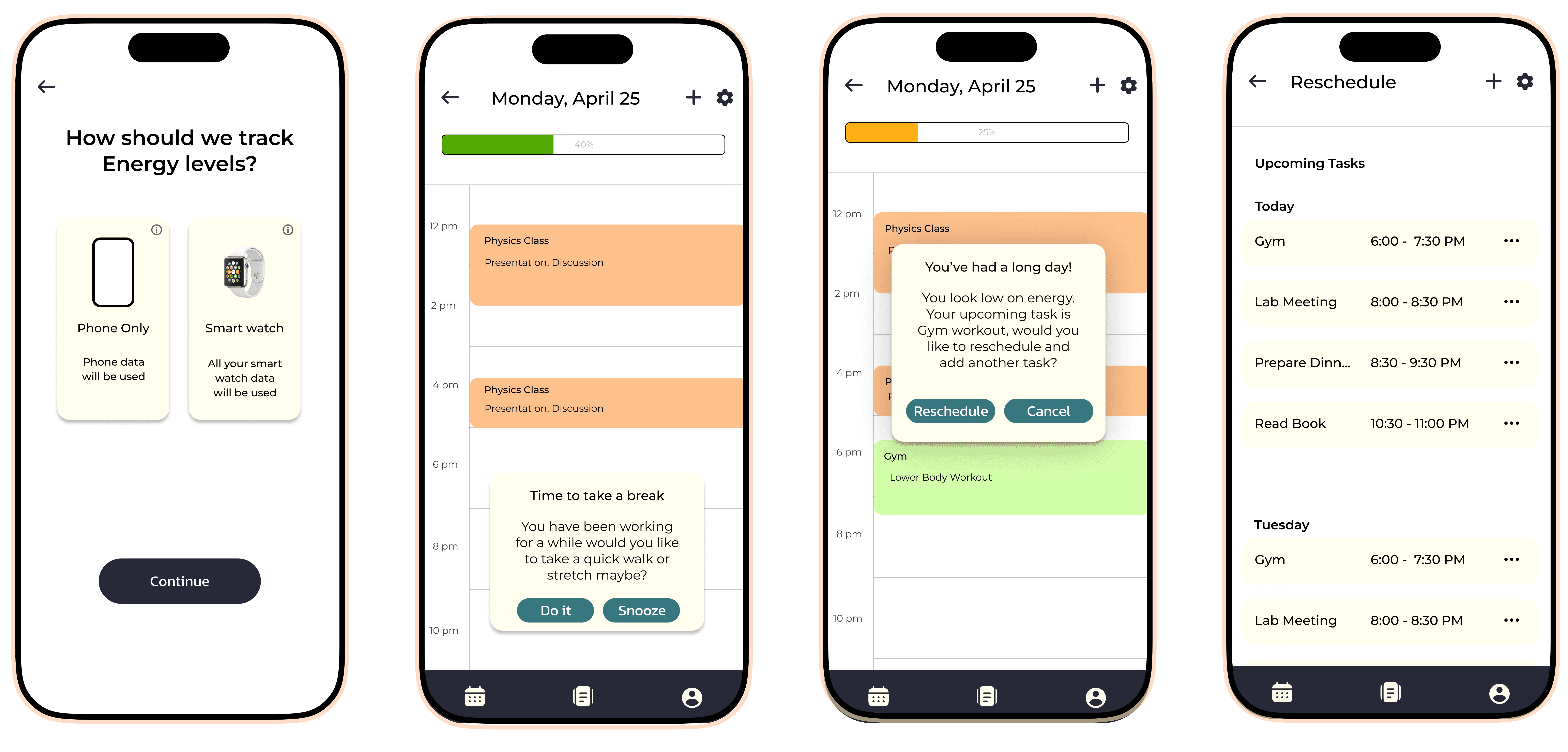
Added the prominent "Time to take a break" banner with one-tap acknowledgment.
After
Calm
Focus-first
Adaptive Logic
Mental wellness
Visual Clarity
Real-world
clarity
06 The Highlight
What Shipped
A working mobile prototype, onboarding flow, energy tracking via phone or smartwatch, adaptive calendar, break nudges, and a rescheduling system. All designed and prototyped in Figma.
Validation approach
The core assumption, that mental clarity beats task history would be validated by tracking daily return rate over a week. A high DAU signals the fresh-start mechanic is keeping users motivated rather than anxious.
Biggest risk taken
Deliberately removing task history entirely. No archive. No overdue labels. No record of what you didn't finish. This was the sharpest design decision and the one with the most to prove.
07 Achievement
Just a thought
Good design solves real problems. FlexPlan turns static calendars into living systems that flex with your energy and your life.